
Tag: cardiogenic shock
Age and Associated Outcomes Among Patients Receiving V-A ECMO
In a multinational study using the ELSO Registry, we found that increasing age was strongly associated with higher risk of hospital mortality and complications among patients receiving V-A ECMO for cardiogenic shock, with... read more
Revisiting VA-ECMO in Infarct-related Cardiogenic Shock
Despite advances in medical therapies and coronary revascularization, infarct-related cardiogenic shock remains a life-threatening emergency with high death rates. Temporary mechanical circulatory support, including peripheral... read more
ECLS in Infarct-Related Cardiogenic Shock
In patients with acute myocardial infarction complicated by cardiogenic shock with planned early revascularization, the risk of death from any cause at the 30-day follow-up was not lower among the patients who received ECLS... read more
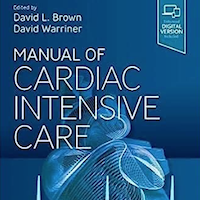
Manual of Cardiac Intensive Care
Addressing the changing needs of clinicians in today’s CCU, ICU and CICU, Manual of Cardiac Intensive Care is an easy-to-use, point-of-care reference for cardiologists, intensivists, physicians, trainees, and other health... read more
Pulmonary Artery Catheter Use and Mortality in the Cardiac ICU
The appropriate use of pulmonary artery catheters (PACs) in critically ill cardiac patients remains debated. There is wide variation in the use of PACs that is not fully explained by patient level-factors and appears driven... read more
Management of RV-Predominant Heart Failure and Shock in the Cardiac ICU
Cardiogenic shock from left ventricular failure is a common presentation in the intensive care unit. In contrast, right ventricular (RV)-predominant heart failure (HF) causing shock is less well recognized. We review... read more
Essentials of Shock Management: A Scenario-Based Approach
This book is designed to offer the reader first-rate guidance on shock management in the real world. Comprehensive, evidence-based, and up-to-date instruction is provided on optimal care of patients with different types of... read more
Percutaneous vs. Surgical Cannulation for Femoro-Femoral VA-ECMO in Cardiogenic Shock Patients
Compared with surgical cannulation, percutaneous cannulation was independently associated with lower in-hospital mortality and fewer complications. Among 12,592 patients meeting study inclusion, 9,249 (73%) underwent percutaneous... read more
The Pulmonary Artery Catheter: A Solution Still Looking For a Problem
In 1970, Jeremy Swan, William Ganz, and colleagues published their seminal paper “Catheterization of the heart in man with use of flow-directed balloon-tipped catheter”. Few devices in our specialty have generated more... read more
Use of Hemoadsorption in Patients With Severe Intoxication Requiring ECMO
Drugs intoxications often lead to severe vasoplegia and cardiogenic shock, and VA-ECMO represents a viable therapy option. However, as cardiopulmonary support is not contributing to the removal of the causal agent from the... read more
Cardiac Injury in COVID-19
Patients with coronavirus disease 2019 (COVID-19) can present with a large panel of cardiac manifestations, including myocardial infarction with (type 1) or without (type 2) obstructive coronary artery disease, arterial or... read more
Pulmonary Artery Catheterization in Patients with Cardiogenic Shock
Very low-quality observational evidence suggests pulmonary artery catheterization (PAC) use in patients with cardiogenic shock is associated with lower mortality. Overall, these results support consideration of PAC for... read more
Dynamic and Hybrid Configurations for ECMO
Dynamic or hybrid configurations for extracorporeal membrane oxygenation (ECMO) are needed when patient physiology or clinical conditions change. Dynamic configurations included configurations converting from veno-arterial... read more
Milrinone vs. Dobutamine in the Treatment of Cardiogenic Shock
In patients with cardiogenic shock, no significant difference between Milrinone and Dobutamine was found with respect to the primary composite outcome or important secondary outcomes. A total of 192 participants (96 in... read more
Managing Patients With Short-Term Mechanical Circulatory Support
The use of mechanical circulatory support for patients presenting with cardiogenic shock is rapidly increasing. Currently, there is only limited and conflicting evidence available regarding the role of the Impella (a microaxial,... read more
Left Ventricular Unloading and ECpella Role
The main reason for the emergency implantation of venoarterial extracorporeal membrane oxygenation (VA-ECMO) is the restoration of adequate systemic perfusion, while protecting the failing heart and promoting myocardial recovery... read more
Hemodynamic Profiling utility using Pulmonary Artery Catheters in Cardiogenic Shock
PAC usage in cardiogenic shock (CS) is being revitalized by recent positive analyses of large registry and administrative databases. To realize the full potential of pulmonary artery catheters (PAC), more research is urgently... read more
Venoarterial ECMO in Elderly Patients with Refractory Cardiogenic Shock
The clinical utilization of extracorporeal membrane oxygenation (ECMO) has seen remarkable expansion since its inception in the early 1970s, including a period of exponential growth in the United States. Venoarterial... read more
Thrombosis and Bleeding in ECMO without Anticoagulation
Extracorporeal membrane oxygenation (ECMO) causes both thrombosis and bleeding. Major society guidelines recommend continuous, systemic anticoagulation to prevent thrombosis of the ECMO circuit, though this may be undesirable... read more
VA-ECMO to Rescue Sepsis-induced Cardiogenic Shock
Patients with sepsis-induced cardiomyopathy with cardiogenic shock have a high mortality. This study assessed venoarterial extracorporeal membrane oxygenation (VA-ECMO) support for sepsis-induced cardiogenic shock refractory... read more
Massive PE with Intra-hospital Cardiac Arrest and Full Recovery of RV Function after vaECMO
The concept of vaECMO treatment alone might be a valuable alternative in selected patients with massive PE and cardiogenic shock, in whom thrombolytic therapy might not unload the RV fast enough. We present a case of a... read more
Potential Therapy for Improving Sudden Cardiac Arrest Resuscitation Outcomes
The severity of cardiogenic shock following asystolic cardiac arrest is dependent on the length of cardiac arrest prior to cardiopulmonary resuscitation and is mediated by myocardial stunning resulting from mitochondrial... read more